Compare Two Actual Coolers Before Comparing Two Brand Names
YETI versus RTIC becomes a useful camping comparison when you put exact models beside one another and ask what the difference buys for your trip. A familiar logo, a discount banner, and a shared size number can hide meaningful differences in interior shape, empty weight, accessories, and the space each box occupies in a vehicle. Neither brand is a single cooler design. For a practical reference point, this guide looks at the YETI Tundra 45 and RTIC 45 QT Ultra-Tough using manufacturer information checked on October 19, 2026. It does not treat them as identical-capacity boxes or claim a hands-on ice test. The aim is a purchase decision you can explain: which cooler gives you the useful space, handling, and ownership terms you need at a price you consider worthwhile. That decision can reasonably differ between campers who take the same length of trip. Someone loading a narrow vehicle alone may value a dimensional or weight difference more than someone carrying the cooler a few steps with a partner. Put those everyday tasks at the center of the comparison so the final recommendation reflects a real camping routine.
A: Their names do not establish that; compare published interior measurements and real packing needs.
A: On October 19, 2026, the checked RTIC listing displayed $239 versus $325 for the Tundra.
A: The checked Tundra listing was 24.60 pounds versus RTIC's 29.5 pounds.
A: No. It does not claim a controlled hands-on retention test.
A: The checked Tundra listing includes one; the RTIC page lists its compatible basket separately.
A: They may solve a specific vehicle packing or access constraint.
A: It can change price, but the exact configuration must still meet your practical requirements.
A: No. Read the current terms for the exact product and seller.
A: When its total cost and physical arrangement suit your needs and its listed weight is manageable.
A: When its particular dimensions, lower listed weight, accessories, or verified terms solve a meaningful need.
Start With a Clearly Defined Comparison
The Tundra 45 and 45 QT Ultra-Tough belong in a discussion of substantial hard coolers, but the similar numbers in their names do not establish equal usable volume. Compare the interior and exterior measurements separately and account for the exact model generation. Do not substitute a wheeled cooler, soft bag, or lighter construction from either brand midway through the comparison. Those products may be good alternatives, but they answer a different question. A consistent shortlist keeps the decision understandable.
Set your own requirements before looking at the price difference. Write down the containers you use, the available vehicle space, who lifts the cooler, and how long your normal trip lasts. Include the cold source and any organizer you intend to use. These are constraints that neither brand name can settle on its own. A smaller or heavier box might still fit your routine, but the compromise should be deliberate and visible.
The Current Listings Show a Real Price Gap
At the October 19 check, the YETI Tundra 45 page displayed $325, while the RTIC 45 QT Ultra-Tough page displayed $239 for its shown configuration. That is an $86 difference before applicable tax, shipping differences, or added accessories. Treat these as dated listing observations rather than permanent prices. Check your selected color, seller, and included equipment again before purchasing, because a promotion or a different configuration can change the value calculation.
Capacity Needs More Than Matching Numbers
YETI lists the Tundra’s interior at 18.3 by 9.4 by 10.7 inches, and RTIC lists its model at 18.90 by 11.42 by 10.98 inches. These measurements help show why the two products should not be treated as interchangeable merely because both names include 45. They also reveal only part of the packing experience. Interior shape, corners, baskets, and the dimensions of actual food containers still matter. Use the published measurements to plan a test load rather than to invent a precise capacity claim from a rectangular calculation.
A wider interior may accommodate a container arrangement that is awkward in a narrower box. Conversely, a narrow shape can be enough for your menu and may fit a particular storage gap better. Compare the food and ice you expect to carry, not a hypothetical maximum load of identical cans. Include the most awkward item, such as a broad prepared-meal container or a tall bottle. If that object controls the arrangement, a modest dimensional difference can be more consequential than the headline price.
Keep capacity claims in their original context. A can-only count and a count involving ice are not equivalent packing demonstrations. Even when two brands describe cans similarly, those counts do not tell you how a family’s mixed groceries will fit. A home mock-up using the listed internal dimensions can narrow the decision, but a real fit check remains preferable when possible. Avoid comparing unlike marketing numbers as though they were a standardized camping-food test.
Empty Weight Changes the Ownership Experience
The checked pages list the Tundra 45 at 24.60 pounds and the RTIC model at 29.5 pounds. That makes the listed empty-weight difference 4.9 pounds for these two particular products. Neither figure includes the food, containers, and ice that you will add. Consider the complete lift from the ground, over a vehicle sill, and back down at camp. A small specification difference becomes more relevant when one person repeats that lift throughout the season.
Decide how much that difference is worth to you rather than assuming the lighter box automatically wins. Someone who moves a cooler once with a partner may judge it differently from someone loading alone every Friday. Handle shape, grip position, and the available lifting space affect the task as well. If you can inspect both products, try the carrying position without exceeding a safe manageable load. The practical comparison should reflect your movement, not just the arithmetic.
Exterior Dimensions Must Fit the Vehicle
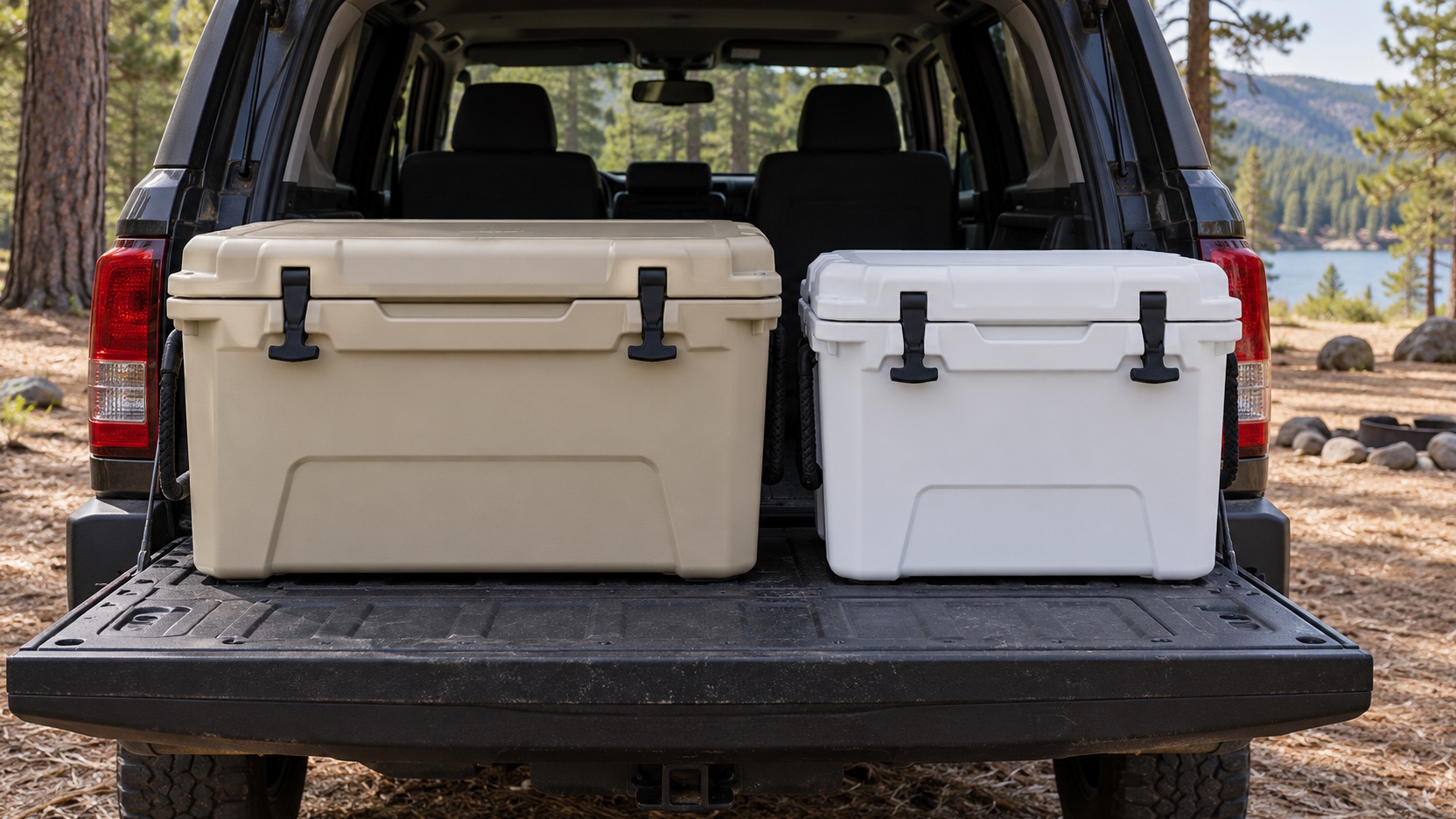
YETI’s listed exterior is 25.6 inches wide, 15.9 deep, and 15.5 high. RTIC lists 26.35 by 18.19 by 15.75 inches. Those differences can matter beneath a cargo shelf or alongside another rigid item, especially in a smaller vehicle. Measure the route through the opening as well as the final storage space. A cooler that fits the floor area but prevents the hatch from closing does not solve the packing problem.
Lid access deserves a separate check. Some camping setups keep the cooler in a vehicle or on a slide, and the lid must open without striking shelves or forcing the whole chest to move. Account for carrying handles and the space needed to reach latches and drain components. Do not assume an exterior measurement describes all operating clearance. Think about the box while it is being used, not merely while it is stowed.
This is also the place to consider a different model from either brand. If neither reference cooler fits your vehicle well, forcing a choice between them may be the wrong exercise. A smaller hard cooler, a different shape, or a planned two-cooler arrangement could solve the actual problem. Keep alternatives separate from the reference comparison so the reasoning stays clear. The best value comes from a product that fits the trip, even when it is not the model you expected to buy.
Count Included Accessories Honestly
The checked Tundra listing includes one removable dry-goods basket, while the RTIC page lists its compatible basket and freezable divider as separate accessories. That difference belongs in the purchase comparison only if those items serve your packing plan. Add the current cost of anything you genuinely need to the relevant product total. Do not assign a large theoretical value to an accessory you would leave at home. Equally, do not call two prices equivalent when one still requires a purchase to match your intended setup.
Do Not Invent an Ice-Retention Winner
A fair retention comparison needs equivalent loads, starting temperatures, ice amounts, ambient conditions, and lid-opening routines. Manufacturer descriptions can explain design intentions, but they do not substitute for a controlled head-to-head test. This guide therefore does not declare either reference cooler the winner of an experiment it has not performed. Compare any published claims with their stated conditions and keep your own food-temperature checks in the plan. A confident purchase does not require an unsupported performance ranking.
Your use can matter as much as the chosen model. Organizing retrievals, starting with properly chilled supplies, and providing enough cold source make the cooler easier to manage. These habits do not guarantee a fixed number of days, and they do not turn visible ice into a complete food-safety assessment. Use suitable temperature monitoring and follow current handling guidance for perishable food. The useful question is whether your complete routine works reliably, not which logo appears beside the longest day count.
Compare Support, Returns, and Replacement Needs
Read the current written warranty for the exact product and purchase channel rather than relying on a brand’s general reputation. The YETI product page links a five-year warranty, but eligibility, exclusions, proof-of-purchase requirements, and remedies belong in the actual terms. Check RTIC’s current terms directly as part of your purchase decision as well. Do not infer equal or unequal coverage from an accessory warranty or an old discussion about a previous model. Ownership terms deserve the same model-specific attention as measurements.
Return logistics can be particularly valuable when you are uncertain about fit. Check the return window, condition requirements, and potential shipping costs before placing an order. A heavy cooler is a substantial object to send back if it misses a vehicle clearance by an inch. If a local inspection is available, use it to evaluate handles, latches, and lid movement. Reducing uncertainty before checkout may be worth more than chasing a small additional discount.
Think about likely wear points and whether replacement parts are offered for them. Drain components, latches, and other hardware can affect long-term usefulness, but availability may differ by model or change over time. Verify the parts you care about instead of assuming an entire brand has a universal service advantage. Keep purchase information and care instructions with your equipment records. A useful warranty and a product you can maintain are practical ownership considerations rather than abstract prestige.
When RTIC Looks Like the Better Value
The RTIC reference model is a strong candidate when its current lower purchase price, listed interior dimensions, and intended construction suit your needs and the added empty weight is manageable. Its value case is clearest when the saved money remains meaningful after required accessories and purchase terms are considered. For a camper whose vehicle easily accommodates the exterior footprint, the extra depth may not create any difficulty. The decision still requires checking current specifications and your actual load. Lower cost is persuasive when it comes with a suitable product, not when it distracts from a known mismatch.
Make the choice explicit: perhaps you can comfortably handle the weight, your food containers fit well, and you do not need to pay extra for an organizer. Those are reasons connected to the trip. Avoid claiming that RTIC offers the same performance in every respect simply because the products look similar. A value judgment can favor one model without pretending the two are identical. That distinction keeps the recommendation useful to someone whose priorities differ from yours.
When the YETI Premium Can Make Sense
The Tundra reference model deserves consideration when its listed lower empty weight, narrower exterior, included basket, or verified ownership terms solve a problem you actually have. Decide whether those differences justify the current premium for your frequency of use and transport routine. If they do not, there is no need to invent another reason to spend more; if they do, the less expensive alternative is not automatically better value. Recheck both selected listings before purchase and choose the cooler whose complete package fits your camping life. A sound brand comparison ends with specific priorities and acknowledged tradeoffs, rather than a universal winner.